One person, several homes
One renter asking about several homes should get one conversation, not several. What we decided, where each piece stands, and what ships next.
Rewritten 10/9, midday (Fede: must-haves only) · Updated 10/11: the follow-up restart is decided and in the merge queue · Decided · shipping · Sources: Jay Taylor’s three emails (Western Slope, 10/8) and sections 27 and 53 of the leasing-engine design page.
Oct 29 follow-up: The prospect record across homes: audit of all 118 real tour cards, the per-home facts hole and lead-source bugs, with decisions D1 to D3.
Contents
The short version
The problem. At Western Slope, one renter asking about several homes got several of everything: duplicate AppFolio cards, split conversation threads, and doubled follow-up texts.
The decision. One person = one conversation = one follow-up clock. A home is a fact inside that thread, never a second thread. A second home that arrives while that clock still owes a message restarts it from the top, anchored at the new home (Fede, 10/10: “Build it and ship”). No switches: these are fixes to live behavior and go live everywhere on merge.
Ship order. Match listing-site leads to the person we know (done). Stop the stray second inquiry (done). One conversation per person and the repair of the 10 split people (done 10/9). Then one follow-up clock per person, then the “which home?” question and the application to the chosen home.
The full page
Where it stands
| Must-have | Status | Proof or date |
|---|---|---|
| A listing-site lead with no phone or email is matched to the person we already know | done | Live 10/8, PR #18085. Tested on 9,987 real cards: 827 right joins, 7 doubtful. |
| A second home no longer creates a stray inquiry or a reply on the wrong address | done | Live 10/9, PR #18112. |
| One conversation per person across all their homes | done | Merged 10/9, 2:25 PM (PR #18286), live everywhere, no switch. Proof: every customer’s book replayed unchanged, Camellia model inputs byte-identical 22/22, Willows and Fairhaven live runs, four planted defects red; review found two real bugs in the stop rule, fixed before merge. |
| Repair the 10 Western Slope people already split across threads | done | 10/9, 12:30 PM. 5 people folded to one written thread each, messages in date order, one live duplicate follow-up stopped; the other 5 only had calls, which stay as separate records by design. |
| One follow-up clock per person that knows every home | done | Merged 10/9, 4:05 PM (PR #18305), live everywhere, no switch. One message names every home. Proof: 1,703 inquiries replayed, one-home prompts 3,308 with 0 differences; Willows and Fairhaven live runs; review found one real gap (a second home inheriting an empty schedule), fixed before merge. |
| A second home restarts the person’s one follow-up track | merged, live everywhere | Fede ruled restart 10/11. PR #18673 (the restart) and PR #18674 (fallback text names every home) merged 10/11 and were in production before 11 AM; the harness and replay code merged as #18812, #18676 and #18823; the follow-up wording fix (#18827, every follow-up names each home the person asked about) and the gone-home hand-off (#18831) merged 10/11 afternoon. No switch. Proof: unit 17/17 with a planted defect red; 9,443 real people replayed before and after (peak clocks owing a message per person 5 → 1; people with two clocks 913 → 0; 40,449 messages both sides; 1,082 restarts for 913 people; one-home people byte-identical); the real workflow replayed with 0 faults. Willows live run: right after deploy. |
| The “which home?” question, plus the other reply-writing improvements | done | Shipped 10/9 (PR #18351) as "Clara knows every home's state"; the narrowing question itself stayed out (12% in replay against a 70% bar). Replay: 97 of 115 multi-home steps pass (51 on the old code); one-home prompts 1,275 of 1,275 identical. |
| The application goes to the home the renter chose | done | Merged 10/9 (PR #18351). The application goes to the home the renter named in the message Clara is answering; two homes named means she asks. Replay 18 of 18. |
| Clean up duplicate AppFolio cards | done | 7 Western Slope duplicate cards marked Inactive, reason Duplicate, history kept (Bow’s second card included); AppFolio Merge not used (needs their Leasing CRM). Jay’s own test card 236 not yet confirmed. |
| Inactive, Cold or Waitlist on one home, with a reason | not building | Fede, 10/9. |
| New screens or panels before the behavior is proven | not building | Fede, 10/9. |
How it works
2978 Emerald: open
363 Ember Ln: rented
Clara keeps one record and one conversation per person. A second home is a new turn in the running thread (“You also asked about Oak St. It’s open; want to see it with Elm on Saturday?”), never a second first email. Most second homes arrive days later, so this turn is the normal case, not the edge.
Follow-ups are wakes, not timers, as on the vision page: when the clock fires or a new home arrives, Clara is woken with the whole picture and writes the next message, or waits.
The job is to narrow to one: answer about every home, ask one question that splits the set, get at least one tour (several are fine), then send the application for the home they chose.
The model is ours, not AppFolio’s: Clara’s records hold the state and each property system is a mapping, so it works with any PMS and any lead source.
Retro 10/10: the first same-moment case
What happened
Saturday 10/10, 12:49 PM MT, Western Slope. Clayton Barnfield’s Rent.com card arrived in AppFolio with two homes: 2841 Morningside Ct and 2978 Emerald Cir. Clara made one person and one conversation, as designed. But she sent two first emails 55 seconds apart (12:51:48 and 12:52:43). The second opened “good to hear from you again” and offered different tour times.
Two follow-up clocks started; they fold into one at the first wake, as designed. Nothing went unanswered. Fede: “the first time we get two interests it breaks.”
Why the design missed it
The design assumed the second home arrives days later (“most second homes arrive days later, so this turn is the normal case”). The number that would have tested that was asked for on 10/9 and not delivered until 10/10.
| When the second home arrives | Western Slope (259) | Situs (956) | All (1,215) |
|---|---|---|---|
| same minute | 2% | 10% | 8% |
| 1–10 min | 6% | 13% | 11% |
| 10–60 min | 3% | 4% | 4% |
| 1–24 h | 8% | 16% | 15% |
| 1–7 days | 27% | 25% | 26% |
| over 7 days | 54% | 31% | 36% |
Gap from the first home’s inquiry to the second home’s, by AppFolio Received minute, same 9,443-person history. Within ten minutes it is the same AppFolio card 148 of 237 times.
Reading: the right bet for Western Slope’s scattered homes, the wrong one for a centralized company like Situs, where one in four second homes lands within ten minutes. There, same-moment is the normal shape, not the edge.
Why the harness missed it
The replays (1,703 inquiries) and live runs graded what Clara says, how many people and cards she makes, and the follow-up clock. No test case had two homes arriving together on one card, and no check said “one outbound per person per arrival.” The first email’s content was right (it named both homes); the count was never checked.
Where Clara still speaks per home
| # | Path that messages a prospect | Fires once per | Already-spoke check |
|---|---|---|---|
| 1 | First email on a new card or new home | inquiry | none across homes (the cause) |
| 2 | AppFolio “New Lead” notice, engine | inquiry | skip if the conversation has messages |
| 3 | Notice, generic | message | 30-min first-touch claim |
| 4 | Text reply | message in the person’s thread | per message |
| 5 | Email reply | message in the person’s thread | per message |
| 6 | Follow-up texts and emails | inquiry clock, folds to one per person at first wake (Fede 10/10: not acceptable; one per person from the start) | 12-hour per-person cooldown |
| 7 | Re-engagement | armed once per person | 12-hour cooldown |
| 8 | Tour texts and reminders | tour | per tour (correct) |
| 9 | Application links | tour, or person + home | per tour / per person per home (correct) |
| 10 | Post-tour chase | tour | 12-hour cooldown |
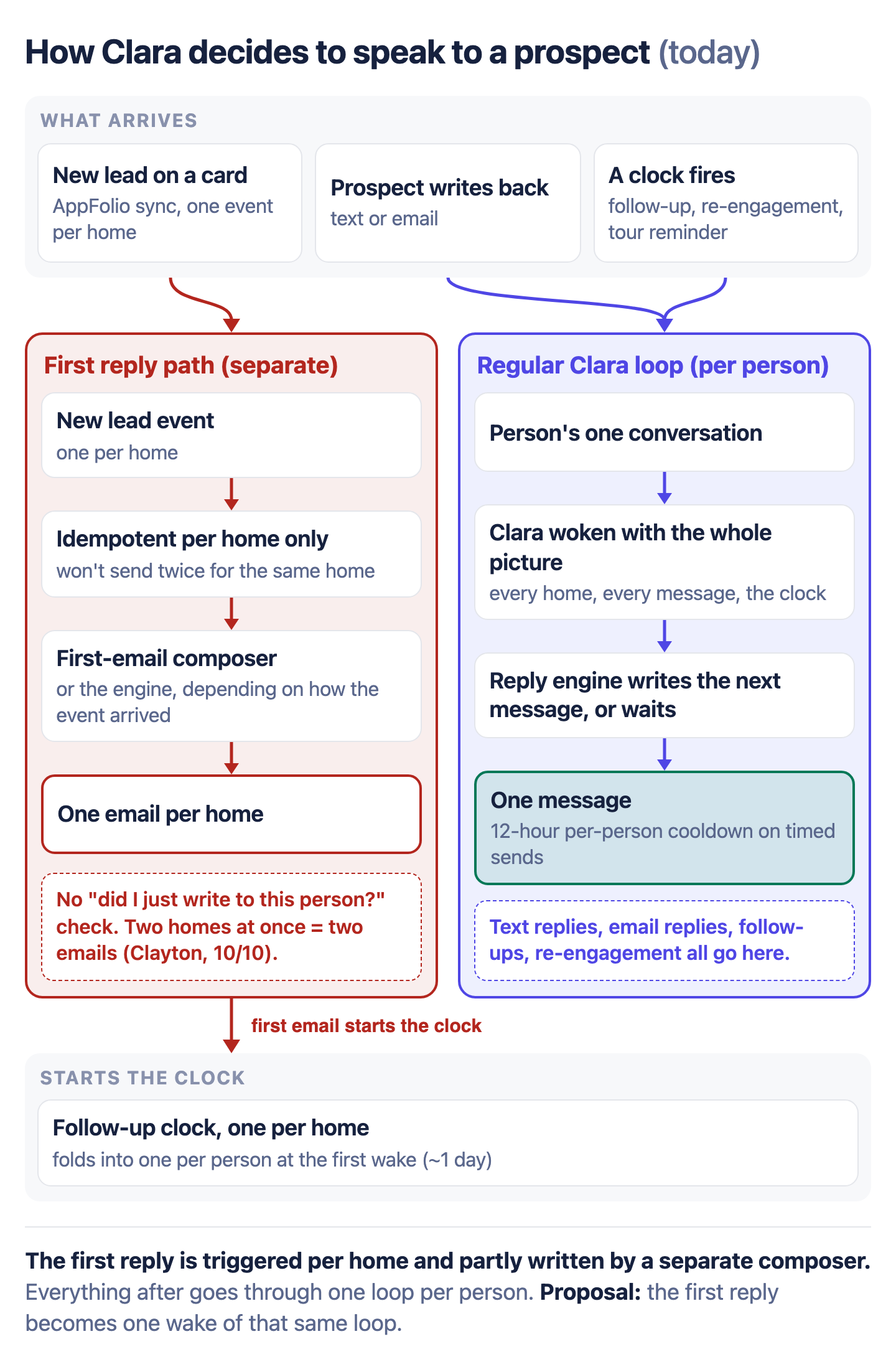
“Isn’t it the same Clara?” No. The first reply fires per home from a lead event. When a second home arrives as its own event, that reply is written by a separate first-email writer, not the engine that writes every later reply. The context is the same (every home); the trigger, and sometimes the writer, are not.
No existing rule would have stopped email 2: the 12-hour cooldown covers only timed paths, the first-touch claim only blocks the other path, the “already answered” check is same-home only, and duplicate protection is per inquiry.
Name rule, checked
Bow (10/8, 3:55 PM) and Anna Neil (10/3) were not auto-joined because both arrived before the rule merged (10/8, 8:17 PM); replayed, it would have joined both. The rule fires only on a new listing-site email lead, never on card sync, and never revisits existing records, so Anna stays split until a merge rule exists. Not a bug.
Fede’s ruling, 10/10 (supersedes the proposal above)
“If someone inquires about a home we do want to reply within 30 seconds. If that person submits another inquiry it should be the same person, same conversation; it’s fine to do another email, ‘you’re also interested in this.’ Clara knows there are two homes, the follow-ups know there are two homes, but there is one per person. That was the whole point. The hard-coded 12-hour thing makes no sense. Back to the test harness, extend it with this use case, try again. This is a failure.”
- The first reply stays fast. No settle window before it. A second home arriving later gets its own short turn in the same conversation.
- Follow-ups: exactly one per person at all times, keyed to the person. Not per-home timers that fold a day later.
- No hard-coded time windows as guards. The 12-hour per-person cooldown was never approved and goes away in the redesign; other windows (the ~20-hour gap, the 30-minute first-touch claim) are listed and reviewed the same way.
- The second email to Clayton was acceptable. The two timers were the failure.
Order:
- Extend the multi-home harness with Clayton’s real case (two inquiries on one card seconds apart): assert one person, one conversation, at most one first email per home, and exactly one follow-up track per person that names both homes, with a planted control; must be RED on today’s code.
- Redesign the follow-up clock to be per person, reviewed by Fede.
- Build.
Status: harness extended and RED on today’s code (10/10 afternoon, branch fede/multihome-harness-same-moment, npm run harness:person-first, case 10). Red check: right after the second home arrives, the person has two follow-up clocks instead of one, for about a day until one folds into the other. Green on today’s code: one conversation, at most one first email per home, one follow-up per touch naming both homes after the first wake. Correction: the 12-hour cooldown is not what blocks the second follow-up; the fold at first wake is, and the harness shows the same output with the cooldown at zero. Finding: the 10/9 PRs (#18286, #18305) were proven with unit tests and one-off replays, not a committed harness; this case is now the first committed one. Redesign build in progress on a local branch; no PR until Fede reviews before/after.
Day-two check, 10/11, 12:52 PM: the renter got exactly one follow-up. Both per-inquiry clocks woke within a minute; the home A clock sent one text and the home B clock saw it and closed. So the fold held in production. The wording is the weak spot: the text said “that home is no longer available” without naming which of the two, offered home A plus a third home the renter never asked about, and went by text although the whole conversation had been email. This is the live example for Fede’s question about follow-ups being shaped around one home; the redesign’s follow-up text must name every home the person asked about by name.
Hard-coded windows on the follow-up path (none approved by Fede)
| Window | Value | Harness exercises it |
|---|---|---|
| Per-person cooldown | 12 h | yes |
| Follow-up touches | 24 h / 48 h / 7 d / 14 d | yes |
| Min gap between sends | 20 h | no |
| Final reply grace | 48 h | no |
| Other home still named | 30 d | yes |
| Stale clock cutoff / clock lifetime | 33 d | partly |
| Lead first-touch claim | 30 min | no |
| Quiet hours | 8:00–21:00 property time | no |
| Quiet-hours hold cap | 25 h | no |
| Held touch min wait | 1 h | no |
| First-email consumer claims | 90 s to 30 d (six values) | no |
| Historical lead min age | 3 d | no |
Why a separate first-reply path exists (history, 10/10)
Short answer: yes, Clara still has a separate first-email path. Since 9/24 the regular engine writes the words for most first emails, but about 13,000 lines across 13 modules still run only around the first email, and the old 4,100-line writer still writes the whole email in three cases: a second or third home on the same card (118 of 908 Western Slope cards), a redraft when the planned tour time is gone, and every draft at a company that is not live.
What is separate today
| Concern | First email | Regular reply loop |
|---|---|---|
| Trigger | New-lead event from AppFolio sync or a listing-site email | An inbound message |
| One-per-lead guard | Own record per inquiry, event lock, 30-min first-touch claim | The conversation itself |
| Review hold | Own hold call, before any conversation exists | Shared prospect-email sender |
| Sending | Low-level sender directly; shares only the template | Shared prospect-email sender |
| Booking | Planned at draft, booked at release, cancelled if never sent | Booking tool during the turn |
| Checks | Fact trace, draft checks, auto-rewrite, body check, turn wrapper | Shared safety checks |
| AppFolio | “Email Sent” record + assign Clara | No AppFolio note |
| Who gets an answer | System-created cards only | Everyone who writes in |
| Prompt | Extra 6-clause “first touch” block | Shared email rules |
How it came to be
| Date | What | Why |
|---|---|---|
| 9/18–19 | First-email record, prep, send and review hold built | Western Slope launch dark and reviewable; composing through the inbound pipeline left a visible empty “ghost” conversation on every held card |
| 9/18–19 | System-cards-only rule | Fede: “lets just make it so we only reply to system guest cards” |
| 9/20 | Wired to the new-lead event | Fede: “We should not be coupling AppFolio at all with the core agent loop” |
| 9/20–21 | Fede objects to the split | “there should not be multiple reply paths”; “it's insane that we keep building separate things that have issues” |
| 9/24 | Per-inquiry first emails built on the old writer; engine allowed to write behind a per-property switch | Fede: “it doesn't matter if it's the first response or a second. Why is it not using the exact same thing?” Per-inquiry stayed on the old writer because the engine answers about the card's own home only |
| 9/24 | “Retire the composer” PR merged to the integration branch only, never main | — |
| 9/29 | Engine made the only writer; switch deleted; redraft and per-inquiry left behind as “follow-up work” (issue since closed, code still has the exception) | — |
| 9/30 | Listing-site email leads routed through the same pipeline | Fede: “one engine period” |
No PR gives a design reason for keeping per-inquiry on the old writer beyond “the engine turn doesn't do it yet.”
Bugs on the first-reply path since 9/19
| Date | What went wrong | Would a normal engine turn have had it? |
|---|---|---|
| 9/19 | “Call the office” instead of tour times | No |
| 9/20 | “Clara responded” never set | No |
| 9/20 | Draft crashed, card died silently | No |
| 9/21 | Plain-text email, no branding | No |
| 9/21 | No email because the person record did not exist yet | Yes |
| 9/20–21 | Every Western Slope system card skipped | Yes |
| 9/21 | “Pencil you in”, wrong times | No |
| 9/22 | Generic “variety of homes” on 23 of 32 cards | Partly |
| 9/23 | Second and third inquiries never answered | Yes (trigger design) |
| 9/23 | No tour times when no unit named | No, engine later hit it too |
| 9/23 | Double greeting, specs recited, tour for a gone home | Mostly no |
| 9/26–28 | Prep stuck, time-budget timeouts | No |
| 9/29 | Unsized cards lost tour times | Yes |
| 10/1 | One lead answered twice, once per path | No |
| 10/2–5 | Cold first email to someone who already toured, applied or was mid-conversation | Mostly no |
| 10/7 | Returning renter pushed into a tour | Partly |
| 10/9 | Tour offers started tomorrow, skipping today | Yes, every channel |
| 10/10 | Two first emails 55 s apart, second said “again” | No |
Score: 11 of 18 would not have existed as a normal engine turn, 4 would have happened anyway, 3 partly. “Didn't offer a tour the next day” is a recurring symptom, not one incident: it hit the old writer (9/19, 9/23), the engine (9/29) and the shared slot finder (10/9).
What is truly first-reply-specific and must survive a fold: exactly one first email per person (today per inquiry); the system-cards-only guard; hold-or-send decided before any conversation or tour exists; book at release and cancel if never sent; the AppFolio “Email Sent” record and assigning Clara; never cold-email someone who already applied, toured or was answered; tell the team when drafting fails. The prompt rules (greeting, one sentence on a system card, the card's home wins, listing price only, never volunteer a gap, book a requested open time) already live on the engine.
Recommendation (Fede already ruled “one engine” on 9/24 and 9/30; the question is what is left to fold): 1) move per-inquiry and the no-tour redraft onto the engine and delete the old writer, which needs the engine thread to see every home on the person's card; 2) send the first email through the shared prospect-email sender so hold and branding come from one place; 3) have the AppFolio note and the engaged stamp listen to the “Clara replied” event. Structural risk: today the engine turn creates a conversation and books before the hold verdict, and the prep step undoes it; the 9/26–28 timeouts were cleanup failures of this kind. The real fold puts hold, checks and the one-per-person decision inside the engine's own send step.
Redesign 10/10: one follow-up track per person, restarted by a new home
Before: each home started its own follow-up clock; they merged a day later. After: the first home starts the person’s clock. A later home that arrives while that clock still owes a message restarts it from the top: the old clock stops, one new clock starts anchored at the new home, and the next follow-up is Day 1 after the new home’s first reply, naming every home. First replies are untouched: each home still gets its own reply in seconds (“you’d also asked about…”). No settle window, no switch.
Why restart rather than join: follow-ups sent 1–2 days after the person last wrote get a reply about 30% of the time; at 3–14 days it is about 7%. A new home is the person writing again, so the clock should count from there.
Restart, not “start a second clock and fold it later”. The track row is moved to the new home before anything is stopped (one row per person, first writer wins), then the old clock’s run is terminated with the reason “restarted: the person asked about another home” and its row is stamped done the same way the 10/9 fold stamps a folded home, so the old home is still named in every follow-up. Three cases do not restart: two homes in the same moment (the row is claimed but no clock is enrolled yet) join one clock; a repair of a dead clock joins the live one instead of killing it; a clock already in its final 48-hour reply wait is left alone and the new home starts fresh. The old fold stays only as a backstop.
Hard-coded windows: what still matters
| Window | Role now |
|---|---|
| 12-hour quiet gap between Clara’s messages | not needed for one clock Proven with it off. Still skips a touch right after a reply (example 2). |
| 20-hour minimum gap between touches | spacing only |
| 48-hour wait for a last reply | unchanged a new home then starts fresh |
| 30 days: which homes a follow-up names | real Decides content, not count. |
| 33-day clock lifetime, quiet hours | unchanged |
Do follow-ups name every home?
The AI draft and the email subject already named every home. The fixed fallback text (used when a draft fails its checks) named one. Fixed:
Before (fallback)
Hi [name], it’s Clara with Home A following up on your inquiry. Would you like to set up a time to take a look?After (fallback)
Hi [name], it’s Clara with Home A following up on the homes you asked about, Home A and Home B. Would you like to set up a time to take a look?Email and Spanish fallbacks changed the same way. Still one-home: “Clara with Home A” and per-home branding.
Every real person replayed, before vs after
| 9,443 real people (Western Slope + Situs history) | Before | After |
|---|---|---|
| One-home people with an identical follow-up trace | 8,228 of 8,228 (byte-identical) | |
| Multi-home people with 2+ clocks owing a message at once | 913 of 1,215 | 0 |
| Most clocks owing a message for one person at once | 5 | 1 |
| Follow-up messages, all people | 40,449 | 40,449 |
| Restarts | — | 1,082 (913 people) |
Real arrivals, the real start/restart code, a simulated clock, nothing sent. The count of messages does not change; their timing does: every follow-up now lands 1, 2, 7 and 14 days after the person last wrote, and names every home. The real workflow was then replayed on a time-skipping server over the same people (200 multi-home people: 0 faults, at most one owing clock per person, 154 restarts, 1,392 messages, matching the simulation).
Three real renters (scrubbed)
1. Two homes 2 minutes apart: before
Day 0: reply on Home A, then reply on Home B (“you’d also asked about Home A”). Two clocks run for a day, then fold. 4 follow-ups (Days 1, 2, 7, 14); fallback names one home.After (by the rule)
Same replies. B restarts the clock from its own reply, minutes later: the same 4 follow-ups, each naming both homes.2. Second home 19 hours later: before
Home B’s reply starts a second clock; A’s folds 4 hours later. B’s clock restarts: 4 follow-ups (Days 2, 3, 8, 15).After (by the rule)
A’s clock stops before its first touch; B’s reply starts the one clock. 4 follow-ups at Days 1, 2, 7, 14 after B’s reply, each naming both homes.3. Second home 2 days later: before
Days 1 and 2, B’s reply, then B’s new clock: Days 3, 4, 9, 16. 6 follow-ups, 4 days in a row.After (by the rule)
Days 1 and 2 on A, B’s reply, then the clock restarts: Days 1, 2, 7, 14 after B’s reply, each naming both homes. Same count as before; each one now lands 1–2 days after the person last wrote, which is where replies come from.Proof, rollout, risks
| Rung | Result |
|---|---|
| Unit tests, planted defect | 17 of 17 planted “always start” goes red |
| Same-moment harness (the 10/10 case, case 10) | red → green one track after each arrival 1,1; after the first wake 1; names every home; one-home control identical; the “hide the running clock” mutation goes red |
| Full replay of real people | pass above |
| Real workflow replay (time-skipping server) | 0 faults case 10: A terminated as “restarted”, B sends all 4 follow-ups naming both; 200 multi-home people, at most one owing clock each |
| Merge | merged PR #18673 and #18674 merged 10/11 (in production before 11 AM); harness and replay code merged as #18812, #18676, #18823; wording fix #18827 and gone-home hand-off #18831 merged 10/11 afternoon |
| Willows live run, then sandbox company | next right after deploy: one registered tester asks about a second Willows home while a clock runs; expect the old clock terminated as “restarted”, one clock on the new home, Day 1 naming both |
Running clocks drain as today: two still fold at their first wake, no double send.
Risks: two homes arriving in the same moment through two different consumers can still start two clocks, because the sibling list is read eventually-consistent (the fold catches it at the first wake; tracked as issue #18678); if the new clock fails to start after the old one was stopped, the daily repair job re-enrols the home; AI-written follow-ups were not regenerated (examples show fallback text).
Willows production run, 10/11
Setup. Sandbox company only: Home A = the Willows (guest card by the robot), Homes B and C = Yale 25 Station sandbox (Zillow-style lead email into its leasing inbox). Three test renters on our own test mailbox. No timer shortened; the reset is proven from the workflow history. Production was on commit 26f84cf686 (includes #18673).
Why C is a second renter. A property keeps one inquiry per renter, so a renter cannot ask about two Yale homes as two clocks. “Third home while the clock runs” is therefore Renter 1: Willows clock running, then Yale 3.5 minutes later.
| Renter | What happened (UTC) | Clock result |
|---|---|---|
| Renter 2: A + B at the same moment | Willows card 19:52:29, Yale email 19:53:14. Yale engaged first (19:54:10, run 01a12c87-abcf). Willows engaged 38 s later. | restart Yale run terminated 19:54:48.597, reason “restarted: the person asked about another home”. New Willows run 01a12c88-3deb started 19:54:48.683, first wait 86,399 s (next wake 10/12 19:54:48). One running clock. |
| Renter 1: C while the clock runs | Willows anchored 19:54:12, run 01a12c87-b13e running. Yale email 19:56:42; Yale engaged and anchored 19:57:34.538. | reset Willows run terminated 19:57:34.909, same reason. New Yale run 01a12c8a-c7a1 started 19:57:35.01, anchor 19:57:34.538, touch 0, first wait 86,399.5 s, so next wake 10/12 19:57:34.8 = day 1 from the Yale first email. One running clock. |
| Renter 3: one-home control | Willows card 19:52:37, anchored 19:55:37. | unchanged One run 01a12c88-fb57, day-1 wait, no track row (one-home renters never write one). |
Day-1 wording check, 10/12
| Renter | Day-1 wake | Why nothing was sent |
|---|---|---|
| Renter 1 (Yale holds the clock) | 19:57:35, skipped no-mailbox, retries at +1 h, +2 h, +3 h, then the schedule moves on | The Yale sandbox home has no Microsoft mailbox (no property mailbox, no company mailbox on the sandbox org). The first reply went out through the no-mailbox SendGrid sender; the follow-up sender is Microsoft-only. Sandbox setup gap, plus a two-senders mismatch filed as an issue. |
| Renter 2 (Willows holds) | 19:54:49, stopped closed | The 10/11 run marked its own guest card Inactive at 20:01 UTC as cleanup; the sync turned that into a closed inquiry, and a closed home never gets a follow-up. Correct behavior; the test killed its own proof. |
| Renter 3 (one-home control) | 19:55:37, stopped closed | Same cleanup. |
Re-run started 10/12, 2:24 PM MT. One new renter, Yale email first (20:24:14), Willows guest card 214 second (engaged 20:26:00). One conversation, Willows holds the one clock, day-1 wake 10/13 20:26 UTC (2:26 PM MT), sent from the Willows mailbox. Nothing is closed until that text is read. Expected: the text names The Willows and Yale 25 Station and no other home.
Harness lesson: never close or mark inactive a test card before the last proof rung has fired; closing is correct engine behavior and ends the clock.
Why restart and not join for Renter 2. Join only happens when the first home has claimed the clock but not started it yet. Yale’s clock was already running 38 s before the Willows home engaged, so #18673 restarts. That is the intended rule.
| Track row (one per renter) | Before | After |
|---|---|---|
| Renter 1 | none (one home) | holder = Yale inquiry b3fa965b, claimed 19:57:34.765 |
| Renter 2 | none | holder = Willows inquiry f77da55d, claimed 19:54:48.343 (Yale held it for 38 s) |
| Renter 3 | none | none |
| Emails the renters got | Conversations |
|---|---|
| Renter 1: Willows first email 19:54:12; Yale first email 19:57:37 (“You’d also asked about The Willows”) | 1 both homes in one thread |
| Renter 2: Yale first email 19:54:14 (“You’d also mentioned The Willows”); Willows first email 19:54:48 | 2 one per home |
| Renter 3: Willows first email 19:55:37 | 1 |
One first email per home in every case. No texts: the test phones are fictional 555 numbers.
Finding, outside the clock change: when two homes arrive within a minute, each opens its own conversation, so the renter gets two threads. The clock is still single. Follow-up candidate for the conversation-joining code, not a #18673 defect.
Cleanup. Willows cards 209, 210, 211 marked Inactive (reason Duplicate) by the robot at 20:01; Yale has no AppFolio cards. The three test clocks are left running and will send their day-1 follow-ups to our own test mailbox around 19:55 UTC on 10/12. The older stray clock from the 10/8 test (person 2727b016) is also still running, untouched. All writes are in the production write ledger.
What’s next
Every step climbs the testing ladder: replay of every customer’s real book, byte-identical where nothing should change → Willows live run → Fairhaven sandbox.
- PR 1, one conversation per person (today). Proof: full replay with one-home cases byte-identical, then Willows, then Fairhaven.
- Task 2, repair the 10 split Western Slope people (done 10/9). Proof: each surviving thread’s message count equals the sum of its parts, and the Bowmuxlow and Tessa Adams pages read in date order.
- PR 2, one follow-up clock per person. Proof: replay shows one nudge per person, never one per home, then Willows and Fairhaven.
- PR 3, the “which home?” question and the application to the chosen home. Proof: the narrowing question well above 20 of 50 on the replay, one-home cases unchanged, then Willows and Fairhaven.
- Task 3, duplicate AppFolio cards (later). Proof: a dry-run list of every card to touch before any write; we do it, never Western Slope’s staff.
- No-show marked in AppFolio (from Jay, 10/9). Done 10/11 (PR #18697): a staff-recorded no-show now flips the AppFolio showing to No Show. Before: staff tells Clara “he didn’t show”, Clara stamps the tour as a no-show in PropFlow and writes the card note, and the AppFolio showing stays Completed. Design: the same staff reply also flips the AppFolio showing to No Show through the robot (the robot’s cancel-showing action already takes a no-show status, but AppFolio rejected its guessed value on 10/9; the real action must be captured first). No switch; a fix to live behavior. Proof: Willows showing #10 on test card 107.
Open for Fede
- Merge on Western Slope cards: does AppFolio’s action menu show Merge on one of their cards? Recommend: check one card; if not, Mark Inactive plus a note.
- Jay’s card 236: Mark Inactive by hand now, or wait for a robot action? Recommend: the robot action later, with the card cleanup.
- New home mid-follow-up: Decided 10/11: restart. Restart from the top, anchored at the new home (Fede: “Build it and ship”). Shipping as PR #18673. See the redesign.
- Staff on the phone line: handed to the vision page. Recommend: keep it there, out of this work.
Appendix: evidence
Tables behind every number above
Name rule, tested on every card we hold (10/9)
| Window | Right joins | Joined to a different contact | Typo on the contact | Unknown |
|---|---|---|---|---|
| 3 days | 661 | 5 | 3 | 9 |
| 7 days (shipped) | 827 | 7 | 3 | 12 |
| 14 days | 935 | 9 | 3 | 14 |
| 30 days | 1,003 | 12 | 7 | 19 |
9,987 cards, all customers, all years. The 7 doubtful joins are old Situs cards from 2022–2023.
Replays of real Western Slope leads
| Replay | Without the fix | With the fix | Wrong joins |
|---|---|---|---|
| 42 email leads, 9/29–10/8: new people | 16 | 10 | 0 |
| Same: new AppFolio cards | 16 | 10 | 0 |
| Same: home added to an existing card | 13 | 19 | 0 |
| 61 email leads since 9/15: new cards | 22 | 17 | 0 |
Same-name collisions (2,993 cards, 2025 on)
| Rule | Real duplicates fixed | Strangers merged |
|---|---|---|
| Before: same home only | 0 | 5 |
| Any home, 30 days | 56 | 3 |
| Any home, 14 days, fake names blocked | 52 | 2 |
| Any home, 7 days, fake names blocked, two same-name people = no match (shipped) | 48 | 0 |
| 30 days without the two-match guard | 58 | 6 |
Reply prototype (10/9, offline, 57 masked people)
| Moment | Today | Prototype |
|---|---|---|
| First email | 0 of 9 | 9 of 9 |
| Later home mid-thread | 3 of 41 | 39 of 41 |
| Follow-up wake | 0 of 12 | 6 of 12 |
| Text reply | 4 of 9 | 7 of 9 |
| After tour | 22 of 22 | 22 of 22 |
| Asks one narrowing question | 0 of 51 | 20 of 50 |
| One-home control steps unchanged | 22 of 22 byte-identical | |
Dataset (full AppFolio history)
| Fact | Number |
|---|---|
| Western Slope older cards opened by the read-only robot pass | 1,703 |
| Western Slope cards with a full activity log | 40% → 95% |
| Who added the extra home (Western Slope) | renter 29% · staff 30% · application under 1% · unknown 41% |
| Homes per person, all customers (9,443 people) | one 87% · two 10% · three or more 3% |
| Second home arrives the same day | Western Slope 16% · Situs 37% |
| Applications per person | always one home |
Industry (research 10/8)
| Question | What the market does |
|---|---|
| One record per person, one per property under it? | Yes: AppFolio, Entrata, Funnel, Knock, EliseAI. Older one-card-per-property survives in Yardi Voyager. |
| Where status and source live | On the per-property record, not the person. |
| Duplicates | Matched on phone or email, merged by hand. Nobody documents listing-site relay addresses. |
| Several homes | Vendors cross-sell when the first home does not fit; none documents narrowing a set the renter brought. |
Not built, by ruling
| Not built | Ruling |
|---|---|
| Closing one home with a reason in AppFolio (Inactive, Cold, Waitlist) | Fede, 10/9 |
| Any new screen before the behavior is proven | Fede, 10/9 |
| A switch or setting on any of this | Fede, 9/30 and 10/9 |
| A “possible duplicate, merge?” button or queue | Fede, 9/8 |
| A timer that waits for more homes before replying | Section 53 |
| Handing cleanup to the client’s staff | Fede, 9/30 |